U.S. News
The End Of Mega Box Data Centers
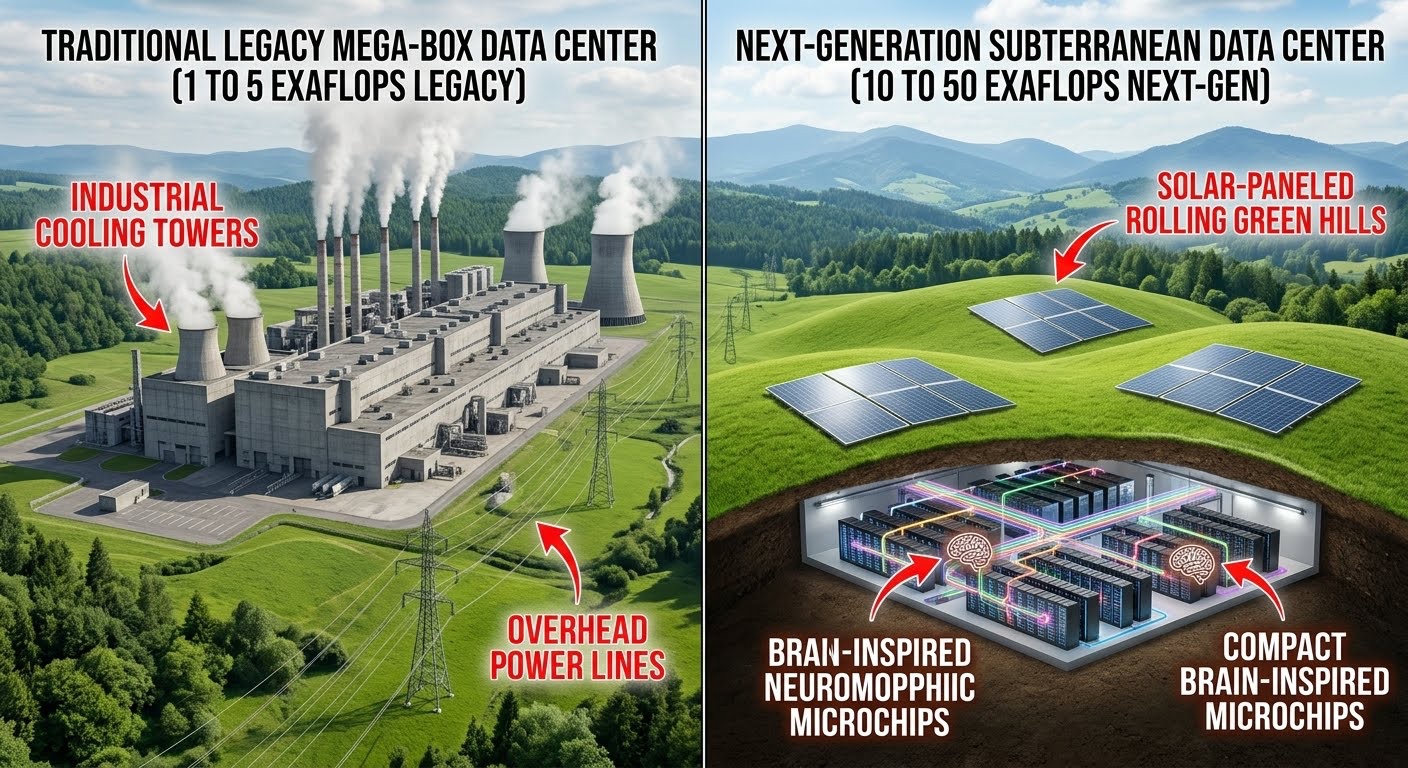
The artificial intelligence boom has triggered a massive infrastructure crisis. Traditional "mega box" surface data centers have become industrial blights on our landscapes. These multi-acre concrete warehouses are grid-dependent monstrosities, consuming over 100 megawatts to a gigawatt of power. They generate constant, low-frequency acoustic noise pollution from massive industrial cooling fans and swallow millions of gallons of water to counteract the heat of legacy silicon. This sprawling framework yields only 1 to 5 ExaFLOPS of total facility AI compute, heavily bottlenecked by power loss in copper networking. Conversely, a convergence of next-generation tech shatters this model entirely. Subterranean architectures move facilities completely underground, routing multi-terabit data seamlessly via mesh silicon photonics pathways of light at up to 64 Tbps. This data layer links directly to brain-inspired neuromorphic processors. Because these analog neural networks operate via event-driven spiking cycles, energy consumption drops below 1 picojoule per operation. The thermal problem vanishes. These self-cooling, zero-noise underground chambers deliver an astonishing 10 to 50 ExaFLOPS of compute power in less than a quarter of the physical space. The era of the multi-acre concrete scar is ending; the future of hyperscale compute belongs to the silent, invisible underground.
Send this to someone
A civic square for verified Americans, open to the nations of the world, its leaders & ambassadors. Reading is open to everybody. Posting, replying and voting are for members.