Food, Water, & Natural Environment
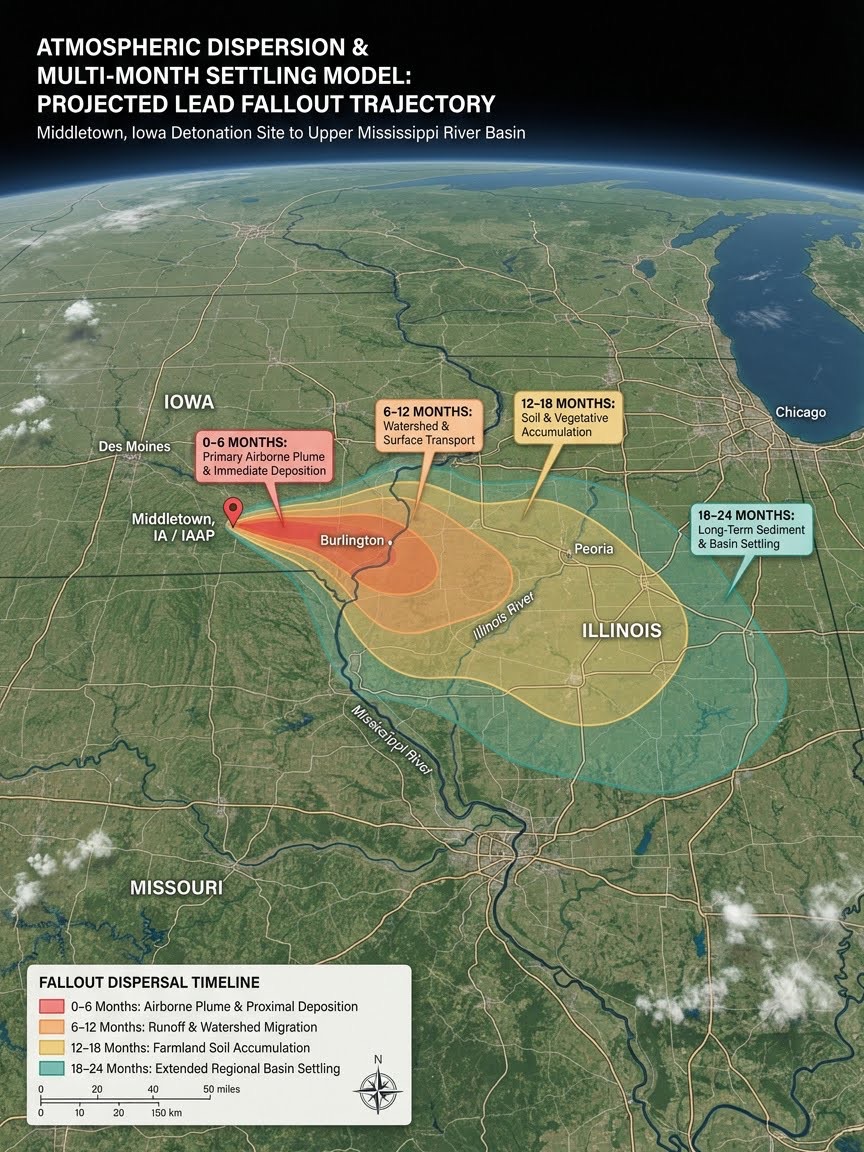
Tomorrow morning, the U.S. Army is set to proceed with a high-stakes controlled detonation of nearly five tons of degraded lead azide at the Iowa Army Ammunition Plant in Middletown, Iowa. While military officials argue that approaching freezing temperatures could destabilize the volatile stockpile and trigger an accidental blast, the chosen solution—an open-air detonation moving forward after a federal appeals court lifted a temporary stay—carries grave environmental and public health consequences for the Midwest heartland. When roughly 9,500 pounds of material composed largely of lead is detonated, the immediate threat takes the form of an aerosolized toxic dust plume. Depending on prevailing wind currents, modeled projections indicate this particulate cloud could drift 60 to 100 miles beyond the installation, sweeping across southeastern Iowa, the Mississippi River watershed, and neighboring western Illinois. For an intensely agricultural region, that fallout trajectory is deeply alarming. Unlike organic pollutants that break down over time, heavy metal particles settle onto topsoil, pastures, crops, and surface water, where they persist indefinitely. Local farmers now face the daunting reality of contaminated grazing land, stressed livestock, and long-term soil remediation—an ecological burden that cannot simply be washed away overnight. Equally urgent is the immediate respiratory hazard posed to communities directly in the plume’s path. During the critical first 48 hours, microscopic lead particles suspended in the air create an acute inhalation risk. Once breathed deep into the lungs, aerosolized lead bypasses many of the body’s natural defenses and enters the bloodstream directly, acting as a potent systemic neurotoxin. Public health agencies warn that there is no safe level of lead exposure; individuals with asthma or pre-existing respiratory conditions face heightened airway irritation, while young children and pregnant women remain acutely vulnerable to irreversible developmental harm. Advising residents to seal windows, shut off furnaces, and shelter indoors offers only temporary mitigation against an unprecedented release. True public safety requires transparent, real-time air monitoring, rigorous soil and water testing, and full federal accountability for the long-term health of the land and people downwind.
Read the discussion More in Food, Water, & Natural Environment
More in Food, Water, & Natural Environment
Send this to someone
A civic square for verified Americans, open to the nations of the world, its leaders & ambassadors. Reading is open to everybody. Posting, replying and voting are for members.
