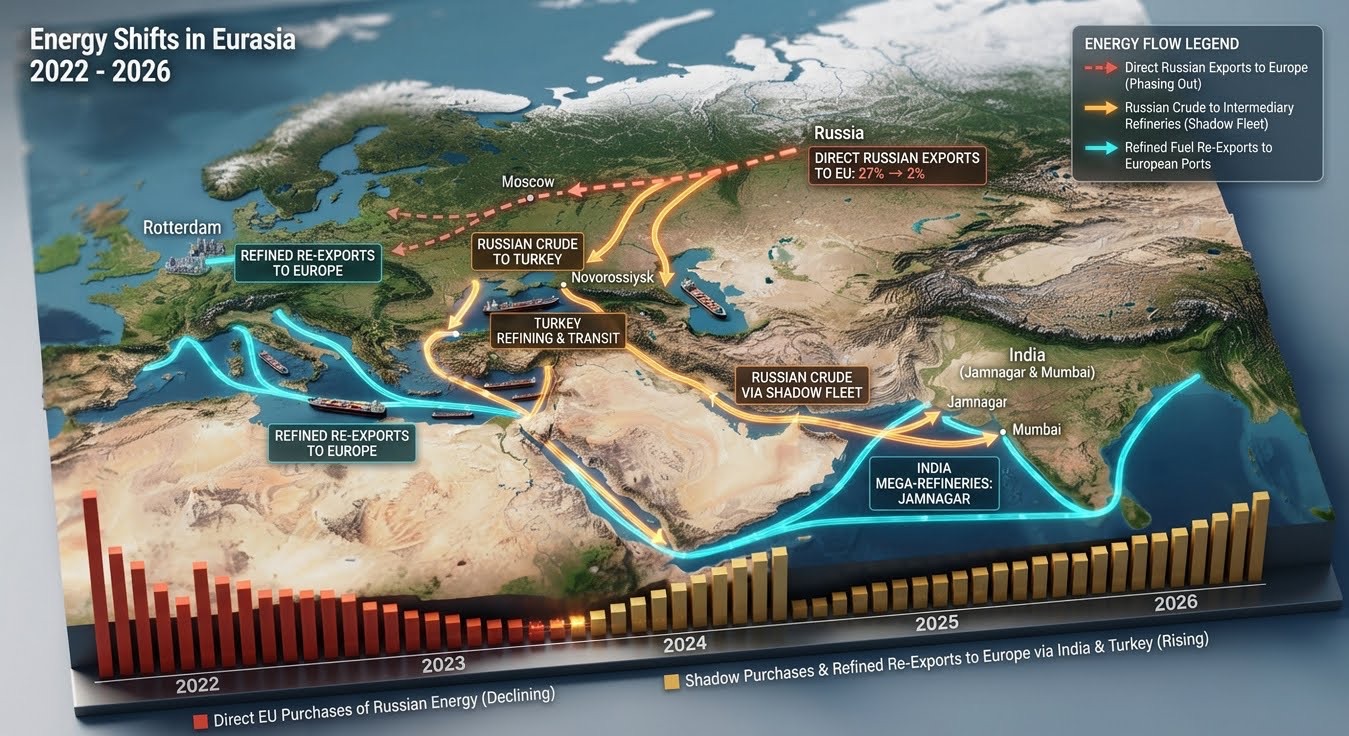
This paradox defines the geopolitical reality of the Russia-Ukraine conflict. While European NATO members pour tens of billions of dollars into arming Kyiv against Moscow, Russian hydrocarbons continue to power European factories, heat European homes, and fuel European jets. Rather than severing ties completely, Western sanctions have rerouted them—giving rise to a vast shadow economy anchored by intermediaries like India and Turkey. When the European Union embargoed Russian crude in late 2022 and imposed a G7 price cap, it left a structural loophole: once Russian crude is refined into diesel, jet fuel, or gasoline in a third country, it is legally reclassified as a product of that transit nation! Neither country joined Western sanctions, and both swiftly capitalized on heavily discounted Russian oil. Using a sprawling “shadow fleet” of aging, uninsured tankers operating with disabled transponders and opaque shell-company ownership, Moscow ships millions of barrels of crude to Indian mega-refineries—such as Jamnagar—and Turkish coastal terminals like Ceyhan and Dörtyol. There, the oil is processed, blended, and seamlessly re-exported at market rates directly back into Rotterdam, Antwerp, and other European ports. For Turkey, the proximity makes the sleight of hand even simpler. Turkish domestic demand is largely satisfied by cheap Russian imports, freeing up Turkey’s own refined output—and sometimes thinly disguised re-exports—for European buyers. Meanwhile, Russian natural gas continues to flow northward through the TurkStream pipeline, keeping Southeast Europe supplied even as traditional Ukrainian transit routes withered. For the U.S. & the E.U., this “laundering” loop is an open secret—and a calculated compromise: a sudden, total removal of Russian barrels from the global market would trigger catastrophic price spikes, monetary inflation, & political costs across European capitals. But in allowing India and Turkey to act as the refining locales, Europe keeps global fuel supplies stable while still forcing Russia to sell its crude at steep discounts, trimming Moscow’s profit margins, yet staying in business with Russia, without facing political opposition domestically. The arrangement underscores the complexity of warfare in an interconnected world where ideology stops at the refinery gate.
Read the discussion More in Global News
More in Global News
Send this to someone
A civic square for verified Americans, open to the nations of the world, its leaders & ambassadors. Reading is open to everybody. Posting, replying and voting are for members.
