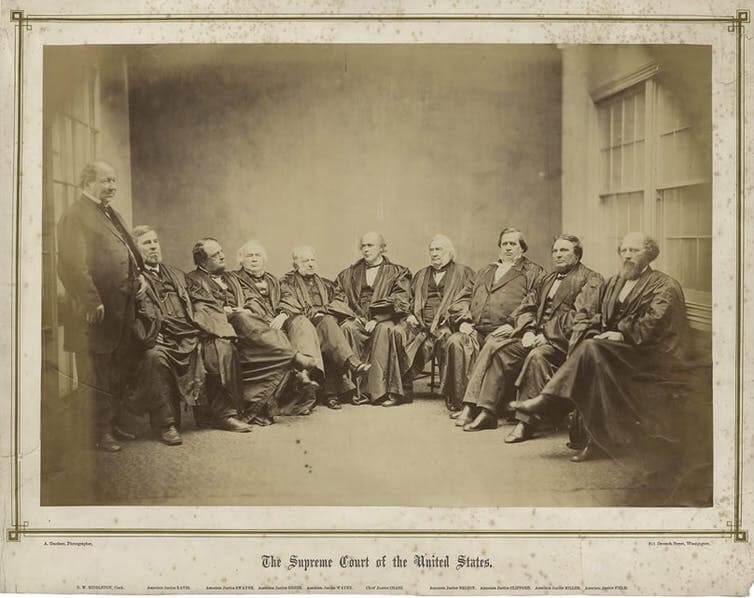
Statutory interpretation of U.S. law is a judicial decision, and yet, do judges have license to re-interpret the original fundamental laws of the Declaration of Independence? For, though the public record of the Continental Congress & the U.S. Congress did show up until 1820 their works to end slavery, in 1803, the Supreme Court indirectly created a factious clause of activism, which allowed an indirect unconstitutionalism narrative that slavery did not oppose the fundamental right of liberty & life. And it was the activist clause created in 1803 by Judge Marshall, which began as an opinion that all sections of law, including the original intent of fundamental law, was open to legal interpretation. Wherefore, Lincoln objected, defending and describing his research of the public works of the founding fathers through 1820, that at all points they labored to maintain the sanctity of the Declaration of Independence, legislating constantly to hinder, limit, & stop slavery, finding it anathema to the founding purpose of the Declaration of 1776 & Constitution. Hence, statutory activism was/ is factious, and unconstitutional, and must be critically reproached in the manner and example of Lincoln and Frederick Douglass, with civility and wholeheartedness. For the original understanding of the Declaration of Independence is the sheet anchor of our nation.
Read the discussion More in American Political Science
More in American Political Science
Send this to someone
A civic square for verified Americans, open to the nations of the world, its leaders & ambassadors. Reading is open to everybody. Posting, replying and voting are for members.
