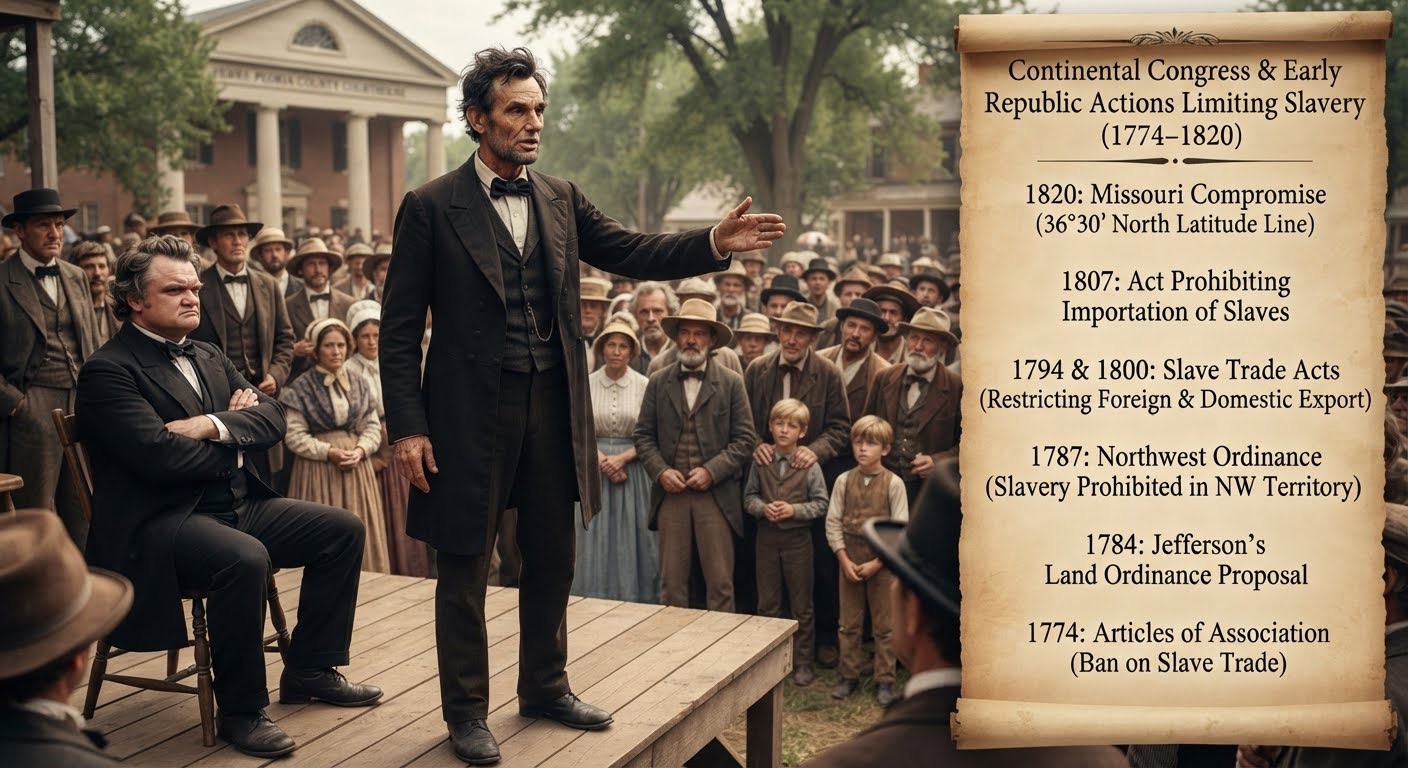
If you read Abraham Lincoln’s speeches and writings, you learn more closely of the man’s heart and mind. Abraham Lincoln spoke from a genuine place within him, using a common language that was easy to understand—speaking directly to the people, not as a condescending, professorial man disassociated from the common person in the United States of America in his time. Instead, he spoke in such a refreshing way that his thoughts and feelings convey clearly as a timeless expression of the living soul. His research into the public works of the Continental Congress and our early federal government through 1820 showed how there was a concerted effort to defend the principles of the Declaration of Independence—so that the Constitution would stand anchored in that fundamental law, which was self-evident, God-endowed, and evidently understood as natural law. By tracing the actions of the Continental Congress and the early federal government—from the 1784 Land Ordinance and the 1787 Northwest Ordinance through the 1807 ban on the international slave trade and the 1820 Missouri Compromise—Lincoln wanted to show ordinary citizens something unmistakable: the Founders did not treat slavery as a permanent fixture to be expanded, nor as a matter of moral indifference. Instead, they treated it as an evil to be hemmed in, restricted, and placed on a path toward eventual extinction, anchored in the Declaration of Independence’s self-evident truth that all men are created equal.
Read the discussion More in American Political Science
More in American Political Science
Send this to someone
A civic square for verified Americans, open to the nations of the world, its leaders & ambassadors. Reading is open to everybody. Posting, replying and voting are for members.
